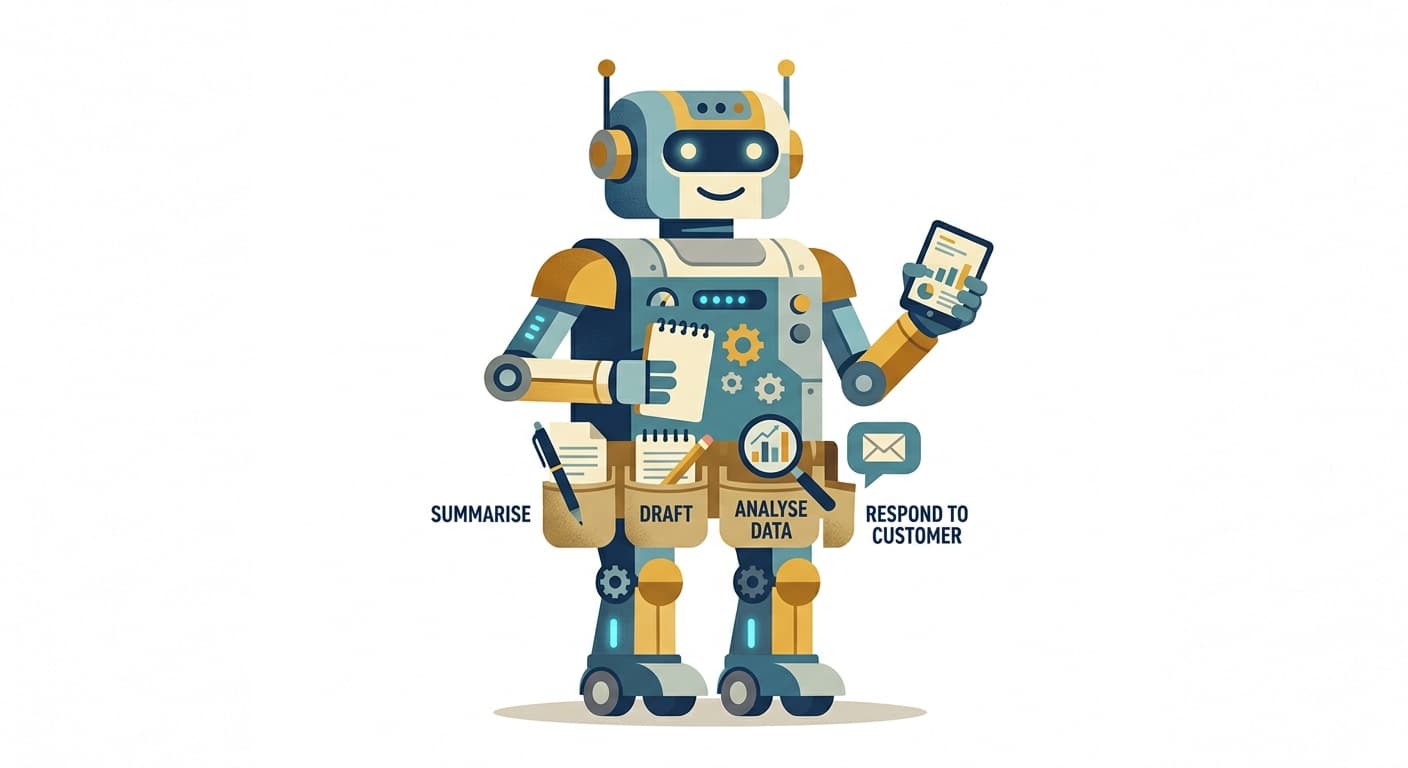
Why AI and Automation Are Better Together
There is a common misconception that AI and automation are the same thing, or that one replaces the other. In reality, they serve quite different purposes — and when used together thoughtfully, they can genuinely change how much you get done in a working day.
Automation refers to setting up systems that perform repetitive tasks without human input. Think of it as a set of rules: "When X happens, do Y." AI, on the other hand, is about generating outputs that require some form of judgement or creativity — writing a response, summarising a document, or making a recommendation based on context.
When you combine the two, you get workflows that are not only automatic but also intelligent. A task gets triggered automatically, AI handles the part that requires thought or language, and the result is delivered without you needing to be involved at every step. For small businesses and individuals with limited time and resources, this kind of setup can be genuinely useful — not as a gimmick, but as a practical way to get more done.
What Automation Actually Does for You
At its core, automation removes you from repetitive loops. If you find yourself doing the same sequence of actions more than once a week, there is a reasonable chance it can be automated. Common examples include:
- Moving data from one app to another (e.g., from a contact form to a spreadsheet)
- Sending scheduled emails or reminders
- Creating tasks in a project management tool when a new client enquiry arrives
- Posting content to social media at set times
- Generating and sending invoices after a project milestone is reached
Tools like Zapier and Make allow you to build these connections between apps without writing a single line of code. You simply choose a trigger (something that starts the process) and one or more actions (what happens as a result). Most workflows take under 30 minutes to set up and can save hours every month.
For a sole trader or small team, even basic automation — like auto-filing email attachments into labelled folders or sending a welcome message to new subscribers — can free up meaningful amounts of time each week.
Where AI Adds a Different Kind of Value
While automation handles the mechanical side of things, AI handles tasks that would otherwise require your brain. Writing, summarising, responding to questions, generating ideas, and analysing text are all areas where AI tools have become genuinely useful for everyday business tasks.
For example, a small business owner might use ChatGPT to:
- Draft a response to a customer complaint in a calm, professional tone
- Summarise a long contract or report into a few key bullet points
- Write a first draft of a blog post or newsletter based on a few notes
- Generate five subject line options for a marketing email
- Answer a specific question about their industry without hours of research
The key word here is "draft" or "first version." AI works best when you treat it as a capable assistant rather than a final authority. You provide the context and direction; it does the heavy lifting of producing a starting point. You review, adjust, and approve. This division of labour is where real time savings come from.
Tools worth exploring include ChatGPT, Claude, and Google Gemini. Each has its strengths, and most offer a free tier that is sufficient for individual or small business use.
A Real-Life Example: The Freelance Consultant Workflow
Let's look at a concrete scenario to show how AI and automation work together in practice.
The situation: Sarah runs a one-person consultancy. Every time she wins a new project, she needs to send a proposal, create a project folder, log the client in her CRM, and set a follow-up reminder. This process takes her about 45 minutes each time.
The solution she built:
- She fills in a short intake form with the client's name, project type, and budget.
- Zapier automatically creates a new folder in Google Drive, adds the client to her CRM, and creates a task in Notion with a follow-up date.
- Separately, she pastes her intake notes into ChatGPT with this prompt: "Write a professional project proposal for a [project type] client with a budget of [amount]. The tone should be warm but direct. Include a brief summary of approach, timeline, and next steps."
- ChatGPT returns a full draft in under 60 seconds. She edits it for 10 minutes, then sends it.
The result: what used to take 45 minutes now takes around 15. Over a month with multiple new clients, that adds up to several hours returned to billable work or simply to rest.
This is not a complex technical setup. It took Sarah about two hours to build and test — and she has no coding background whatsoever.
Getting Started Without Feeling Overwhelmed
The most common mistake people make when exploring these tools is trying to do too much at once. They read about all the possibilities and immediately want to automate their entire business. This leads to confusion, abandoned projects, and the conclusion that "it's too complicated."
A much better approach is to start with a single, specific task that:
- You do regularly (at least once a week)
- Follows the same steps each time
- Doesn't require a lot of nuanced judgement
Once that first workflow is running reliably, you'll have a much clearer sense of what's possible and how to build the next one. Progress compounds quickly once you have a working mental model of how these tools connect.
For AI specifically, the learning curve is even gentler. Start by using ChatGPT or a similar tool for one writing task you do every week — whether that's drafting emails, writing social media captions, or summarising meeting notes. Pay attention to what kinds of prompts give you useful results and refine from there.
Within a few weeks, most people find they have a small library of prompts that reliably produce good first drafts, saving them significant time and mental energy.
Practical Tools to Explore
Here is a short list of tools that are well-suited to small businesses and individuals, with no technical expertise required:
- Zapier — connects over 6,000 apps and allows you to build automated workflows with a visual editor
- Make (formerly Integromat) — similar to Zapier but with more flexibility for complex workflows
- ChatGPT — excellent for writing, summarising, brainstorming, and answering questions
- Notion AI — useful if you already use Notion for notes and project management; AI is built directly into the workspace
- Google Workspace (with Gemini) — AI features built into Gmail, Docs, and Sheets for drafting, summarising, and analysing
- Calendly + Zapier — a classic pairing that automates meeting scheduling and all the follow-up tasks that come with it
Most of these tools offer free plans that are perfectly adequate for getting started. You don't need to commit financially until you've had a chance to see the value for yourself.
Conclusion: Start Small, Build Gradually
AI and automation are not about replacing people or making businesses impersonal. They're about giving you back time — time to focus on the work that genuinely requires your expertise, your relationships, and your judgement. The technology is more accessible than ever, and the barrier to entry for small businesses and individuals has never been lower.
Pick one task this week. Look for a way to take yourself out of the loop. That single step is often all it takes to see what's possible.
If you'd like personalised guidance on applying AI and automation to your specific business, Brain.mt is here to help. Whether you need a one-to-one consultation, a team workshop, or structured training on using AI tools effectively in your organisation, get in touch to find out how we can work together. The goal is always practical, real-world results — not theory.
Follow for weekly AI insights, practical guides, and tool recommendations.
Sources: